
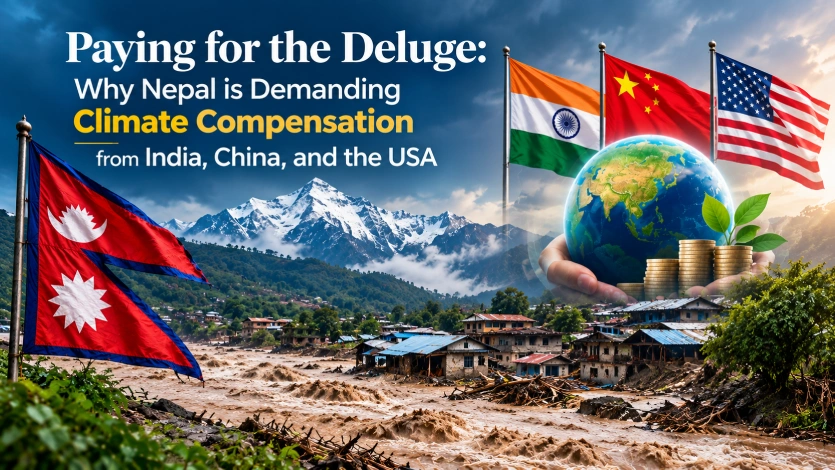
On August 26, 2026, Nepal experienced a flash flood in the Bhotekoshi River basin that caused disruption and took several lives. The flood was triggered by a massive rock and ice collapse near the Nepal-Tibet border that ended up being one of the deadliest incidents. So far, the flood has claimed over 1,240 lives, with nearly 4900 people still missing, while the rescue operations continue. The rescue has allowed more than 11,900 people to evacuate so far, according to authorities, as floodwaters have destroyed several other areas. It includes homes, key bridges, buildings, and critical hydropower infrastructure.
Several countries and famous figures have emerged to help and provide disaster relief or humanitarian aid to the country. As the floods swept entire communities, villages were caught in between, taking parts of Rasuwa, Nuwakot, and Dhading districts in Bagmati Province. Nepal is currently seeking professional help, as the government has appealed specifically for highly specialized equipment and expertise, including tunnel-rescue teams, forensic specialists, and temporary Bailey bridges.
While the rescue operations are going on, Nepal has shifted its primary focus from seeking relief funds to climate compensation. Especially targeting the nations with the biggest greenhouse gas emissions, focusing primarily on India, China, and the US. In essence, this blog talks about how Nepal has approached the United Nations for climate reparations & loss, and describes the background situation.
Why Nepal is at the Forefront
Nepal is surrounded by beautiful mountains and the Himalayas, turning this breathtaking geography into its greatest liability. While it faces the climate crisis at the absolute frontline, the nation is bearing the physical brunt of warming. If its own contribution puts it in an extremely difficult situation, a deadly combination of extreme Himalayan terrain and shifting global weather patterns has uniquely positioned the country as a highly vulnerable environmental flashpoint:
- Extreme Topography: In Nepal, rainfall occurs on very steep and highly prone geologic terrain, thereby making it vulnerable to trigger instant landslides and flash floods. Without giving time for the inhabitants at lower elevations to evacuate.
- Erratic Monsoons: Seasonal rainfall has become completely disrupted because of climatic changes. Dry spells are now suddenly broken by bursts of rain, resulting in deadly surface runoff in the hard soil incapable of absorbing the heavy amount of rainfall.
- Rapid Glacial Melt: In the Himalayan region, there has been significant melting of glaciers due to rising temperatures at a much higher rate compared to other regions across the globe. The large volume of melted glaciers forms lakes, which eventually rupture, resulting in devastating floods.
What is Nepal Actually Demanding and Planning Next?
In the aftermath of the unprecedented devastation, Kathmandu is fundamentally shifting its diplomatic tone. From asking for disaster relief funds and traditional humanitarian aid to seeking climate compensation from bigger nations. The Nepal government argues that a nation contributing a mere fraction of a percent to global greenhouse gas emissions should not bear the catastrophic financial and human costs of a warming planet.
Addressing the public’s growing outrage, government leaders have been highly vocal about the stark inequity of the crisis. Speaking to a local television network recently, Nepal’s Finance Minister emphasized that the country must not be forced to take on crippling international debt. To rebuild infrastructure destroyed by the carbon emissions of other nations. “We are demanding climate justice and rightful compensation, not just financial loans,” the minister stated.
He made it emphatically clear by specifically mentioning the United States, China, and India as the world’s major polluters and carbon emitters. Stating that these countries must take financial responsibility for the severe, climate-induced disasters ravaging the Himalayas. Clearly mentioning that the financial support given to Nepal should be a geopolitical obligation, not an act of charity. Nepal’s Finance Minister also made it clear that they were going to raise this agenda on the global stage.
Kathmandu is currently preparing to use the recent deadly floods as a definitive, tragic case study at the upcoming UN climate summit (COP29) in Azerbaijan. Their primary diplomatic objective is to force the international community to fully operationalize the “Loss and Damage” fund. Nepali delegates will advocate heavily that international climate finance must be distributed as direct, unencumbered grants to highly vulnerable, developing nations.
While engaging in this prolonged diplomatic struggle against time, practical decisions have to be taken on an urgent basis. Realizing that the local authorities have been struggling to cope with the magnitude of the devastation caused by landslides, Nepal is simultaneously working on acquiring specialized foreign equipment. Changing its earlier policy of relying solely on domestic rescuers, the capital city has officially asked for help from India, China, and other nations regarding tunnel rescuers, forensic experts, and Bailey bridges.
Concluding Note!
The recent floods in Nepal were really tragic and devastating, as many people lost their lives, and many are still missing. Search and rescue operations are going on at a rapid pace, with help from many countries coming in. The Prime Minister and Finance Minister of Nepal have also planned their next move and are now demanding climate compensation, grants rather than loans or aid funds. What happens next will be uncovered with time only, but the focus on climate compensation has shifted for many countries.
For example, India itself has started monitoring many Himalayan regions and mountains are keeping a keen eye. While developing and testing technologies that can alert them in advance, much more research is going on. The countries do need to focus on and implement some strict rules on carbon emissions to prevent such devastating incidents in any country.
FAQs
Why does Nepal demand climate reparations?
In this regard, Nepal generates merely 0.1 percent of greenhouse gas emissions but experiences disproportionate damage due to climatic floods. Nepal hopes to receive money to cover the cost of restoration rather than humanitarian aid.
Whom should Nepal approach for compensation?
It intends to claim its rights from the US, China, and India since these three contribute significantly to climate change impacts through large amounts of emissions throughout history. Moreover, they play key roles in triggering disastrous climate change in the Himalayas.
What was responsible for such huge devastation in Nepal recently?
There has been erratic behavior of rains, which have increased exponentially, alongside fast glacier melt in the Himalayas. All this occurs due to global warming, leading to devastating floods and landslide disasters.
Was Nepal seeking international aid for recovery?
Yes. Initially, it had hoped that local bodies would handle this calamity, but Kathmandu quickly realized that the disaster’s scale demanded expert help. International aid such as tunnel rescue workers, forensic specialists, and building Bailey bridges across Nepal by India and China.
How does this connect with the objectives set forth by the UN regarding climate change?
Nepal’s demands coincide with the UN’s concept of “loss and damage.” According to this idea, rich industrialized countries should provide financial compensation to vulnerable countries that suffer due to climate change-induced calamities, although they have nothing to do with creating them.