
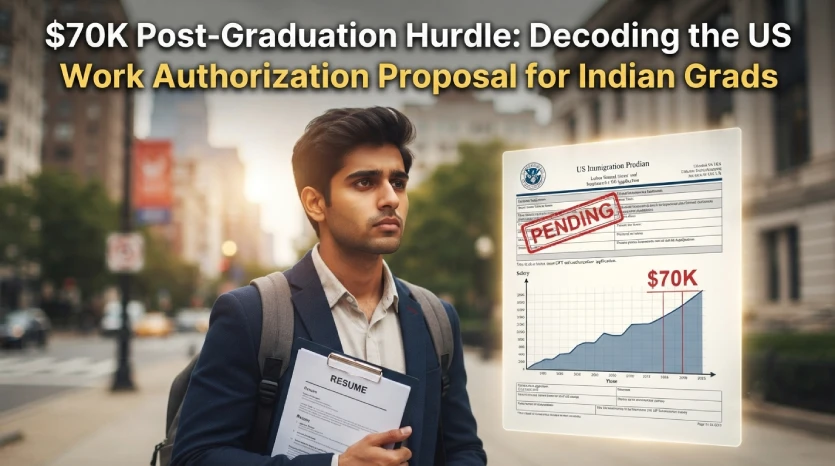
International students pursuing further studies abroad have received a shocker in terms of the proposed $70,000 OPT fee. For years now, the US has been the most sought-after country when it comes to education and employment opportunities after graduating. For students coming from all parts of the world, including India. In other words, the OPT scheme has been playing an essential role for foreign students to get hands-on practical training. This proposal by DHS has caused panic among many who had big hopes regarding their career prospects.
With the introduction of this $70,000 OPT fee, international students have been left with no choice, but to reconsider their plans for studying at American universities. Presently, obtaining a work permit involves just paperwork expenses. But this ridiculous demand from the DHS places a huge burden on international students and the companies willing to employ them. It implies that international students would rather spend money on studying abroad than working there. Moreover, policies like this tend to rewrite the rules and shift the trend of foreign students picking the US as a first option.
What’s Actually in the New DHS Proposal?
Since its inception, the Optional Practical Training Program (OPT) was designed to help F-1 visa holders studying in the United States. To obtain employment within the country during the period after graduation, with an additional 24 months granted to those working. In the fields of Science, Technology, Engineering, and Mathematics. At present, obtaining authorization requires paying only hundreds of dollars to the department concerned.
However, according to a proposal that has been put forward by the DHS, things will become drastically different in terms of the fee structure. Below are some details regarding what this proposed legislation will look like:
A Precedent-Breaking Fee Increase: Under the new proposal, the applicant will need to pay a huge sum of $70,000 towards post-graduation employment authorization.
Rationale Behind the Policy: According to this administration, the main purpose behind implementing such an initiative would be to favor native workers over international ones. Domestic firms are believed to use cheap foreign labor and keep the salary levels low.
Use of Proceeds: The funds collected through the fees will go into financing the entire process of immigration in the US. Without using taxpayers’ money at all, especially for border management and USCIS operations.
Though the above may be true in an administrative sense, the very magnitude of the increase has thrown educational institutions into confusion. It is not just about inflation. It is about rewriting the rules of the game, which is causing a stir on university campuses and in boardrooms across the country.
Why Are Indian Students Majorly Affected?
There has never been any demographic that stands to suffer greater losses from such dramatic changes in policies. Then the large population of Indian students in America. Currently, Indians outnumber all other ethnic groups, emerging as the largest demographic in terms of international students using OPT and STEM OPT programs. However, these students do not get enough financial support from their parents’ savings due to financial constraints. Unlike other wealthy foreign nationals who study abroad and enjoy luxurious lives while pursuing higher education degrees.
For these young Indian minds, the idea of adding a hefty charge of $70,000 is nothing less than impossible. This amount amounts to 58 lakh Indian Rupees, which is a lot seeing the combined costs for completing two-year courses are lower. For a master’s degree from prestigious state institutions in America. All such Indian students consider their career opportunities after graduation from America in order to recoup their investments. By securing jobs in the land of opportunities, which guarantees job stability for these ambitious graduates.
However, if the authorities impose this heavy penalty cost, then the whole equation shall fail miserably. They will be burdened with massive debt but legally priced out of the very job market they trained for. Furthermore, even if the policy allows employers to cover the fee, experts predict that most American companies, particularly startups and mid-sized firms. Will categorically refuse to pay such an exorbitant premium for entry-level talent. Consequently, thousands of highly skilled Indian engineers, data scientists, and healthcare professionals may be forced to abandon their US aspirations and return home empty-handed.
What Are Students Planning For the Future?
It has always been observed that people from other nations come to study in the US. However, the huge costs imposed after completing their studies have now started compelling these international students to look elsewhere. Such changes may lead to long-term consequences that could significantly affect the trend of international students’ migration in higher education globally.
In light of this phenomenon, certain impacts have been seen around the world. Some examples include:
- The consultants engaged in the field are now observing a sharp rise in the number of applications for countries offering work permits at a lower cost after graduation, including Canada and the UK.
- Australia and Germany are both benefiting greatly by relaxing their immigration laws to get highly skilled Indians into the tech industry.
- Universities within America would suffer a huge monetary loss as they depend on paying the entire cost of education by international students annually.
- There will be severe domestic shortages of expertise in the USA tech industry if they cannot manage to hire these skilled individuals anymore.
- In the end, this policy could end up causing harm rather than protecting native workers, as entrepreneurs will find themselves working abroad instead.
To conclude, while trying to fix the immigration system with such a steep price tag, the administration might inadvertently hurt America’s long-term economic edge and hand over its global monopoly on tech talent to other welcoming nations.
Future Outlook on the Proposed DHS Rule
While the anxiety is palpable between students, corporate or universities, it is important to remember that this is only a proposal. In other words, it does not qualify as a legal requirement yet, since it requires going through many processes of legislation and comments. Universities, immigration attorneys, and leading technology firms have begun their preparation for fighting lawsuits and intense lobbying to overturn the decision. Meanwhile, prospective students need to monitor developments related to the matter from DHS and seek advice from immigration specialists before altering their academic future plans drastically.
Wrapping It Up!
The introduction of the $70,000 OPT fee represents a crucial tipping point in global education trends. In the past decades, the United States has always been seen as a land of promise, providing opportunities for promising young talents. With a chance to make a mark on its economic progress. However, this drastic decision by policymakers has erected a formidable barrier in the form of prohibitive cost to replace the once-welcoming culture of inclusion. It leaves universities and companies in America with no option but to watch their prized foreign workforce move into countries where they are welcomed with open arms.
However, defeating this detrimental policy will mean much more than easing financial strain. Overcoming the damaging effects of this $70,000 OPT fee requires robust advocacy from various sectors, both in educational institutions and technology corporations. Should this decision hold, then it would spell the end of the conventional American dream for many Indian students who graduate every year.