
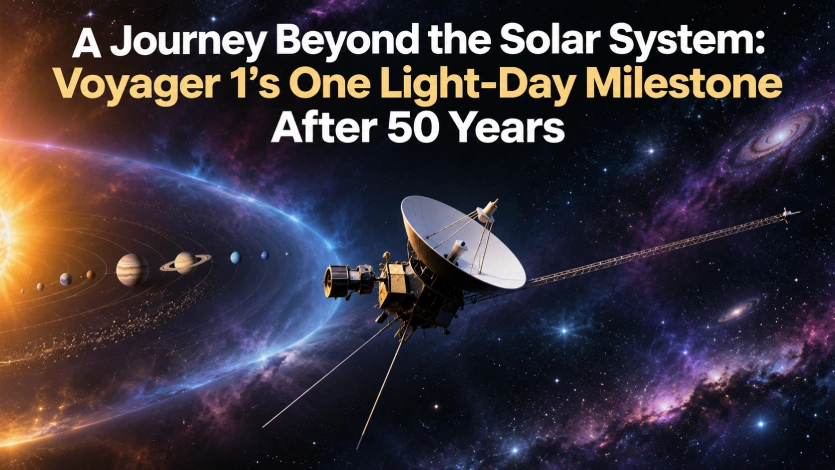
There have been many impossible things done by mankind since the beginning of exploring outer space. Even now, after about half a century since its launch, the NASA Voyager 1 spacecraft continues making history. In a few years, this spacecraft is going to make another impressive journey in outer space. By November 18, 2026, Voyager 1 is going to travel up to one light-day away from Earth and cross another significant milestone for humankind. This essay explores the significance of the accomplishments of the NASA Voyager 1 spacecraft and the reasons behind their importance.
The upcoming accomplishment is not just another great cosmic journey. The NASA Voyager 1 spacecraft has covered a lot of distance in outer space, entered the interstellar space region, sent a lot of information to NASA, and explored areas unknown to humans before. Therefore, NASA can take this opportunity not only to celebrate but also to analyze its 50-year experience of exploration.
NASA’s Voyager 1: History and Achievements on the Journey
One of the oldest spacecraft launched to understand planets and outer space better was Voyager 1, launched on 5th September 1977. Some primary purposes of this spacecraft were to observe Jupiter and Saturn, study their moons, and collect vital data. Working in conjunction with another identical spacecraft named Voyager 2, they took advantage of a rare occurrence. When all planets lined up perfectly due to gravitational forces, both Voyagers visited various planets using gravity assist.
In 1979, Voyager 1 arrived at Jupiter, where it acquired high-resolution pictures while recording lots of useful information regarding its atmosphere, magnetic fields, and moons. Later on, in 1980, when the probe got to Saturn, it conducted extensive investigations and found its biggest satellite, Titan. All of these findings by Voyager 1 contributed to our greater understanding of how the outer solar system works, making it one of the most successful explorations of extraterrestrial worlds by NASA.
Further, the probe traveled out beyond the sphere of influence of the Sun. Ultimately, in 2012, Voyager 1 passed yet another landmark, crossing the heliopause and becoming an interstellar object. This accomplishment made Voyager 1 the first man-made craft to enter interstellar space, bringing forth a brand-new era in the realm of space exploration.
Nowadays, Voyager 1 keeps traveling through interstellar space. Even though the amount of energy it generates is decreasing, NASA technicians devised methods to maintain the functioning of the craft. A one-light-day milestone that is approaching illustrates how the project intended for the investigation of the planets has turned into one of the longest scientific projects.
Key Discoveries Related to Outer Space Through Voyager 1
This spacecraft has been in outer space for several decades and has contributed to major discoveries expanding human knowledge. Regarding the solar system, outer space, and the universe, it also indicates that long-term exploration can be eye-opening.
1. Discovering Active Volcanism on Io
It was NASA’s Voyager 1 that discovered volcanic processes taking place outside Earth on one of Jupiter’s moons called ‘Io’. Not just that, but they discovered that Io is actually one of the geologically active objects in our solar system. Such a discovery changed scientific perceptions towards planetary satellites. In reality, instead of assuming moons to be inert objects, they found some to have their own interior and geology going on beneath them.
2. Understanding Jupiter’s Unique Atmosphere
There were certain amazing discoveries made about Jupiter by Voyager 1. The spacecraft provided imagery of Jupiter’s storms, clouds, and winds. Thanks to such information, humans had a chance to see phenomena such as the Great Red Spot in Jupiter’s atmosphere. Moreover, Voyager 1 studied the influence of the strong magnetosphere and radiation belt on the surrounding area of Jupiter.
3. Exploring Saturn and Its Special Moon Titan
While exploring Saturn in 1980, Voyager 1 made various studies regarding its atmosphere, rings, and other characteristics. However, the mission included an important objective regarding Titan, which is Saturn’s largest moon. The spacecraft found that there was an extremely thick atmosphere composed mainly of nitrogen. These findings made Titan interesting for studying the chemistry of atmospheres and other complicated processes on planets. However, although Voyager 1 failed to take any pictures or obtain any information about the surface of Titan, it made an immense contribution to the development of science as a basis for NASA’s Cassini-Huygens mission.
4. Crossing into Interstellar Space
Another milestone occurred in 2012 when Voyager 1 crossed the heliopause boundary and entered the realm of interstellar space. This milestone was essential since it enabled scientists to conduct research beyond the solar system’s bubble produced by the Sun. There were variations in the plasma surroundings detected by the spacecraft, which provided insight into the area’s nature. Voyager 1 has become the first man-made object ever to explore this area and collect data helpful for research purposes.
5. Taking the Iconic Picture of “The Pale Blue Dot”
The spacecraft took a picture of our pale blue dot while exploring outer space in 1990. The image showed Earth as a tiny point of light against the darkness of space. Although it was not a conventional scientific discovery, the photograph became one of the most influential images in the history of space exploration. It demonstrated the extraordinary perspective available through deep-space missions and offered a powerful reminder of Earth’s smallness within the vast universe. Together, these five achievements illustrate how Voyager 1 has expanded scientific knowledge while inspiring generations to explore beyond our planet.
What’s NASA Doing to Mark and Treasure This Great Event
In the meantime, NASA has started getting ready for the marking and cherishing of this great event, when Voyager 1 will reach a light-day distance from the Earth. This means that Voyager 1 has traveled about 16.1 billion miles or 25.9 billion kilometers and thus has become the first human-made satellite to travel such a great distance. The November 2026 sky-watching guide published by NASA highlights the remarkable achievement of this spacecraft, along with telling about its journey and discoveries.
Final Thoughts!
The upcoming milestone one-light-year journey to be undertaken by the Voyager 1 spacecraft is truly an amazing achievement, which demonstrates how great a man is in terms of his exploratory skills. It was launched a long time ago, in 1977, but since then it has achieved various goals, including studying the planetary systems of Jupiter and Saturn, entering interstellar space, taking photographs of our planet, etc. Thus, this demonstrates that the initial mission to study the planetary systems has become a prolonged discovery mission.
Marking its one-light-day journey, which is anticipated to be reached by the Voyager 1 spacecraft on 18th November 2026. The NASA organization reminds us of the significance of persistence, innovation, and an exploration mindset.
FAQs
What is Voyager 1's one-light-day milestone?
The one-light-day milestone for Voyager 1 means covering up to around 16.1 billion miles away from Earth. In other words, light will travel this far in a day. According to NASA estimates, Voyager 1 would attain this milestone on November 18, 2026.
When was Voyager 1 sent into space?
On September 5, 1977, NASA sent Voyager 1 into space. At the beginning of its journey, it conducted observations and studies of Jupiter and Saturn. Afterward, it ventured into deep space beyond our solar system and became the first man-made object ever to leave the heliosphere.
What remarkable information has been gained from Voyager 1?
Some significant findings of Voyager 1 include discovering active volcanoes on Io, observing Jupiter and Saturn, studying Titan, entering interstellar space, and taking photographs of Earth known as ‘Pale Blue Dot.’
How long will communicating with Voyager 1 take?
Because Voyager 1 is at a distance equal to one light-day, transmitting data to and from the craft would take about 24 hours each way, making the total time frame two days.