
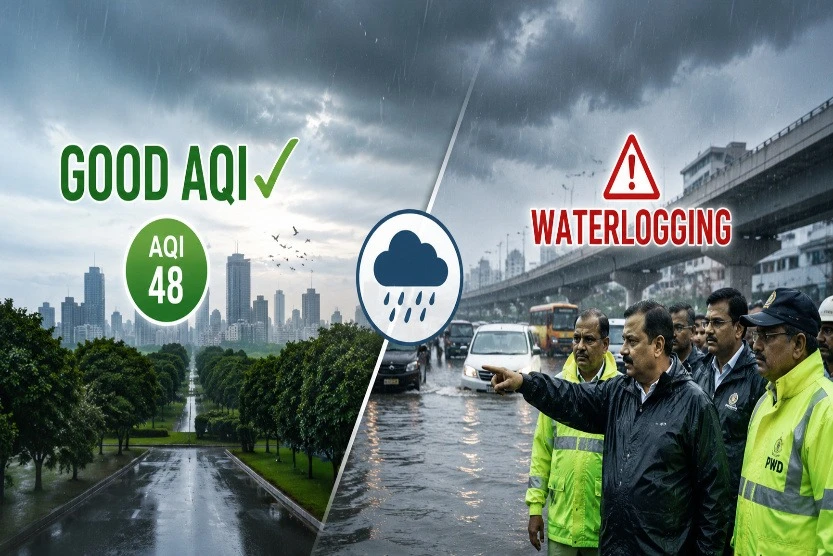
As July begins, so does the monsoon season for India, and although Delhi faces the late monsoon, it comes pouring. From the start of this month, the temperature dropped and became cloudy, but Thursday was the day that made history. As the rain started from midnight goes on throughout the day with little breaks. This long duration of rain resulted in two of the major activities that have been seen and recorded. The very first is the AQI of Delhi, which comes into the good category nearly after three years, since September 10, 2023.
On the other hand, waterlogging problems in a major part of Delhi had been recorded due to heavy rainfall. The city was drowned in the water, making the daily tasks most difficult, and not just Delhi was affected, but also nearby areas. That includes places like Noida or Ghaziabad, which were equally drowned in the water, putting the city at rest. Delhi has faced major problems, while the tweet from former CM Kejriwal questioned the four-tier government work. Therefore, this blog explores both the issues and news spinning around the whole day of rain that Delhi witnessed on Thursday.
The AQI News: Breathing ‘Good’ Air After 3 Years
Finally, Mother Nature has reset the system in terms of the excessively polluted environment of Delhi. The intense showers, which occurred all over the city, have brought the Air Quality Index (AQI) to the rare category. That was a good AQI (below 50) for the first time in almost three years. The rain worked as an enormous scrubber and literally washed away the elevated amounts of suspended particulate matter (PM2.5 and PM10). That usually pollutes the city environment. Thus, people of Delhi woke up and experienced clean skies and breathing clean air, not the usual smog.
Furthermore, not only did the rain help to purify the air, but it also provided some thermal relief. To the tired people who have been experiencing the heat and humidity of the city. According to the meteorological statistics, Northeast Delhi was struck hardest by the showers, experiencing 160mm of precipitation. Such sudden precipitation, along with the wind, significantly reduced the temperature not only in the NCR region but also in the nearby cities of Ghaziabad and Noida.
Below is the list of the positive environmental aspects of such weather conditions caused by monsoon season rains:
| Positive Event | Key Details & Impact |
|---|---|
| Historic AQI Drop | The AQI plunged below 50 into the rare ‘Good’ category, marking the capital’s cleanest air in nearly three years. |
| Natural Air Scrubbing | Heavy showers successfully washed away stubbornly high levels of PM2.5 and PM10 pollutants. |
| Intense Rainfall Data | Northeast Delhi recorded a massive 160mm of rain, violently breaking the dry spell. |
| Thermal Relief | A massive drop in severe heat and humidity across Delhi, Noida, and Ghaziabad. |
Waterlogging: Bringing Delhi & Nearby Areas To A Halt
However, the perfect sky conditions brought very little relief to the people moving around on the streets. Contrasting sharply with the blessings bestowed by nature, the reality of life on the ground in the city became nightmarish very quickly. The heavy rains took over the city’s vulnerable drainage system and brought everything in the bustling city to a standstill. Main arteries in the form of roads and underpasses got inundated, leading to traffic chaos due to waterlogging problems.
The magnitude of the flooding highlighted some serious lapses on the part of the civic authorities in managing the situation. As per the information released by the India Meteorological Department (IMD). This intense localized weather condition was caused by the active low-pressure monsoon trough that was present over the Delhi-NCR region. Though the meteorologists had forecasted the rains, the civic agencies had no clue about it whatsoever.
Here is a table that presents the major civic problems, meteorological causes, and infrastructure failures that arose due to the heavy rains:
| Factor | Ground Reality & Civic Impact |
|---|---|
| Weather System | IMD reported an active low-pressure monsoon trough causing localized, excessive downpours. |
| Infrastructure Failure | Fragile drainage systems completely collapsed, unable to handle the sudden water volume. |
| Severe Waterlogging | Major arterial roads and underpasses quickly transformed into temporary, unnavigable rivers. |
| Traffic Paralysis | Commuters faced massive jams, stranded vehicles, and paralyzed junctions across key hotspots. |
Delhi CM and PWD Minister Hit the Streets for Inspection
As a consequence of the massive civic breakdown and the resident problems, it was not surprising that the Delhi Government sprang into action immediately. Not willing to allow the breakdown of civic facilities to continue unchecked, the Chief Minister and PWD Minister came out of their offices. To get a first-hand view of the situation on the ground. Emergency ground-level inspections were carried out by the officials at multiple points of severe flooding across the capital. By taking this step, they wanted to find out what had caused the complete collapse of drainage facilities. In addition to taking the necessary measures against the concerned civic authorities.
During their on-ground inspections, the PWD Minister undertook a strict, on-the-spot assessment of the entire monsoon preparation of the city. Realizing that the sheer intensity and amount of rainfall in such a short span of time had exceeded. Given the capacity of the systems in place, the officials soon moved to damage control. Massive mobile water pumps were immediately put in place to help clear the water in the worst-hit locations in order to bring back the normal traffic.
Assuring people of Delhi, the government directed field teams to work to seek immediate relief. While promising to better structure fixes to prevent this urban paralysis during the next heavy downpour.
Concluding Note!
The heavy rains in the monsoon season experienced in the city of Delhi recently have highlighted the two faces of the capital. While nature has gifted the city a long overdue cleanup of the extremely polluted air that the city breathes. Bringing about a fresh air quality index for the first time in almost three years. Making the lives of people a lot more comfortable in terms of weather conditions, the flip side to this rare occurrence. That is the lack of preparedness of the city to deal with such an event.
The seasons of rainfall and heavy downpour have introduced the city’s shortcomings in the drainage systems, as roads were flooded. Unlocking the chaos and disorder of waterlogging problems created by the rainstorm has been so much. That even the Chief Minister of Delhi and PWD officials had to make their presence felt through inspections. At the ground zero of the waterlogging situation. In order to allow Delhiites to breathe in fresh air, the administration needs to improve its monsoon readiness.
FAQs
What is the current AQI of Delhi post the recent downpour?
The AQI of Delhi has drastically come down to the ‘good’ level, which is below 50. According to sources, this is one of the cleanest breaths of air experienced in Delhi in the last three years due to the showers.
Why did Delhi NCR have heavy rainfall recently?
As per reports from IMD, the sudden heavy showers in Delhi NCR were mainly caused by the highly active low-pressure monsoon trough that was present over the Delhi NCR area.
What are the locations that received the maximum rainfall?
Northeast Delhi faced the maximum rainfall, which was recorded to be as much as 160 mm. Ghaziabad and Noida are some other locations where there were extremely heavy showers, causing the temperature in the city to fall drastically.
What measures have been taken regarding waterlogging in Delhi?
The chief minister, along with PWD officials, left their offices in order to personally oversee waterlogging sites. They are making efforts to prepare for the monsoon season, using heavy-duty water pumps and ensuring smooth traffic.