
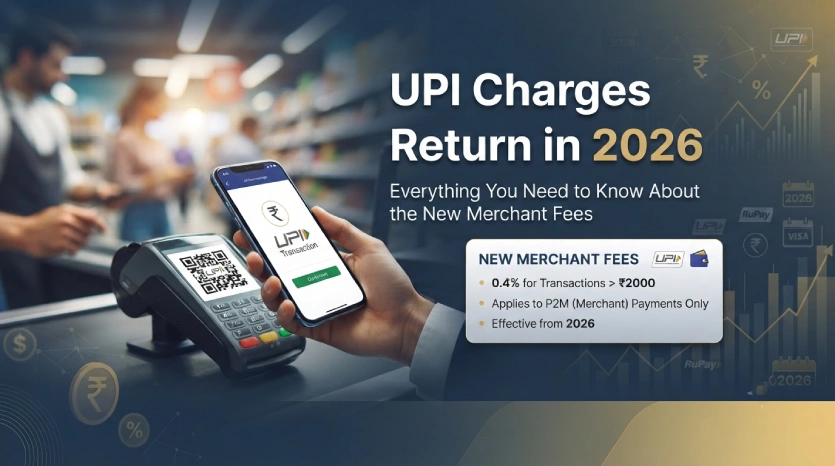
The new set of rules set by the government for UPI charges above Rs 2000 has been notified to people as of September 14. Does that mean every payment made above 2000 will have a charge? No! The rules have their own clauses that clearly distinguish that only payments made from customer to merchant will have charges. Other payments, such as person-to-person or self-transfers, will be free of cost, and so are auto-pay setups using UPI apps. But from the merchant side, he has to pay 0.4% on each payment above 2000.
As per NPCI notification, 0.4% MDR (Merchant Discount Rate) on UPI charges above Rs 2000 will apply starting from October 15, 2026. The government, on 15th September, released an extensive list of FAQs, clearing many doubts for people and merchants. It clarifies that the amount that will be collected through MDR will be used for the participants in the UPI ecosystem. Including banks and payment application providers, and supports digital payments in rural areas where it has not reached.
What is the New UPI Rule?
The new UPI rule simply emphasizes the implementation of the MDR (Merchant Discount Rate) framework in the UPI payments system. Therefore, the new UPI MDR rules primarily mean a certain amount of fee the merchant has to pay. Every time a transaction above Rs. 2000 is made to their bank or UPI app for processing that transaction. Each payment above Rs. 2000 will result in a 0.4% fee, and anything under this will remain free.
For example, transactions of Rs. 75, 000 and above will only result in a charge of Rs. 300 MDR fee per transaction. This new rule will come into play from October 15, 2026, which gives payment aggregators, banks, fintech applications, and even corporate accounting platforms. An adequate amount of time to update their software engines and billing systems.
How Will It Be Implemented?
To clearly understand how this new rule will work in the real world and payment systems, you first need to understand the difference. Between these two types of UPI transactions is P2Pand P2M.
- P2M (Person-to-Merchant): Involves making payments by scanning the QR code in physical stores or paying online through eCommerce platforms, or while paying for services. All P2M UPI transactions that exceed INR 2,000 would attract a 0.4 percent charge on the Unified Payment Interface (UPI).
- P2P (Person-to-Person): Payments made between individuals via the recipient’s mobile number or UPI virtual address without any transaction fee would remain 100% free irrespective of their size.
How is this change in UPI rules beneficial or needed?
Since the launch of UPI, it has witnessed tremendous growth, especially owing to its zero commission rates. In return, it has become highly popular around the globe. Nevertheless, it takes hefty amounts of resources in the form of robust server networks, cybersecurity systems, technology advancements, etc., to process these transactions. By introducing a small fee on high-value business transactions, the government is ensuring that banks and apps. Such as Google Pay, PhonePe, and Paytm) can cover their costs and keep the UPI network running smoothly.
Who Will It Impact?
Whenever news about “UPI charges above Rs 2000” breaks, panic usually follows. But let’s break down exactly who pays what:
1. The Customers (You and Me) = ZERO Impact
It should be crystal clear: everyday buyers are never going to pay even a rupee as additional transaction fees while using UPI. So when you buy a ₹ 5,000-worth smartwatch from an electronics store through UPI, only ₹5,000 will be debited from your bank account. And no processing fees would be charged by the payment apps.
2. Vendors on Street or Micro-Size Shopkeepers = Practically Unaffected
The government decided to fix this threshold value at ₹2,000, and here’s why they chose ₹2,000. The street vegetable seller, the owner of your tea stall, or even your nearby kirana store does not conduct transactions of more than ₹2,000 per transaction. Hence, all their day-to-day business activities would be exempt from the MDR charges.
3. Medium to Large Merchants = They Bear the Cost
These small merchants will not be impacted by the new UPI merchant fee. This particular segment will include boutique owners, restaurants, electronic stores, and similar businesses that accept a ₹5,000 payment via UPI. In this scenario, both banks and payment processors would deduct a 0.4% charge (₹20) on each ₹5,000 transaction. For larger corporations, it is quite common practice to incur fees while accepting online payments through debit cards or credit cards.
4. Fintech and Banks = The Big Winners in Payment Ecosystem
Banks and fintech firms have been processing UPI transactions at negligible costs, almost without charging anything. With this new rule, they will finally generate a sustainable stream of revenue from high-value P2M UPI transactions.
Concluding Note!
In conclusion, the introduction of UPI MDR regulations in October 2026 will prove essential for India’s growth in terms of digital transactions. The main ideology behind the concept of UPI has remained unchanged, it continues to remain absolutely free for its consumers, even when it comes to small merchants’ transactions worth less than ₹2,000.
The charging of 0.4 percent on bigger merchants is essentially done to support the vast technology network needed for efficient and immediate transactions. The implementation of UPI MDR will help keep pace with international standards while providing speed and security at the same time.
Frequently Asked Questions
Will I be charged an extra fee if I make a UPI payment above ₹2,000?
No, you will not pay a single rupee extra. The new 0.4% charge is a Merchant Discount Rate (MDR), meaning it is strictly paid by the business or shopkeeper receiving the money. For example, if you buy groceries worth ₹2,500, exactly ₹2,500 will be deducted from your bank account, and the bank and payment app will take their 0.4% cut from the merchant’s side.
Does this charge apply when I send money to friends and family?
Absolutely not. The new fee only applies to Person-to-Merchant (P2M) transactions. Sending money to your friends, family, or paying your house help falls under Person-to-Person (P2P) transactions. P2P transfers remain 100% free, regardless of how much money you send.
Will local shopkeepers and street vendors be burdened by this fee?
The government has structured this rule specifically to protect small businesses. The 0.4% fee only triggers when a single transaction is strictly above ₹2,000. All merchant payments up to ₹2,000 remain entirely free. Therefore, local vendors, tea stalls, and small retail shops whose daily transactions are usually small amounts will not be affected at all.
How will this impact my UPI Autopay for SIPs, OTT subscriptions, and utility bills?
While Autopay transactions for mutual funds (SIPs), electricity bills, and OTT platforms do fall under merchant payments (P2M), the rule remains the same: the customer does not pay. If your monthly Autopay mandate is above ₹2,000, the billing company or service provider will bear the 0.4% fee. Your investments and bills will continue as normal without any extra user charges.
When does this new rule come into effect, and why is it being introduced?
The 0.4% MDR on large transactions will officially go live on October 15, 2026. This is being introduced to make the UPI ecosystem financially sustainable. Currently, processing massive volumes of UPI transactions requires heavy tech infrastructure, which costs money. Allowing banks and payment apps to charge a small fee on high-value business transactions ensures they can maintain, secure, and upgrade the UPI network for the future.