
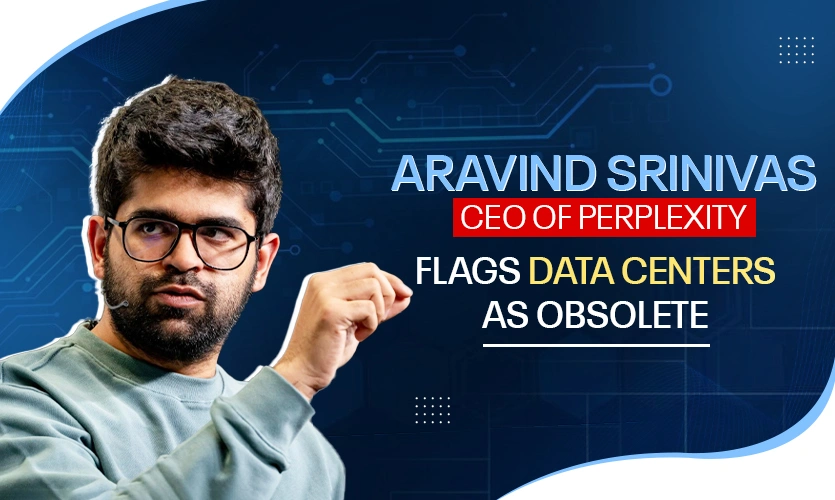
AI has become a rising concern for people across the globe. First, it caught people’s attention due to the job losses people have faced in the IT sector. From there, the AI has continued to grow, with more advanced features, large investments, and million-dollar collaborations among many companies to expand AI. One of the top leaders in the competitive AI search engine space is Perplexity, which has proven its efficiency over time. The CEO of Perplexity, Aravind Srinivas, has made a recent statement that stirred the tech world about Data centers. In a recent podcast with Prakher Gupta on YouTube.
He said, “The biggest threat to data centers is if the intelligence can be packed on a chip locally. That’s running on the individual’s device, and then there’s no need to interfere with all of it in one centralized data center.” Let’s explore the background of this young billionaire with Indian roots and the accomplishments that have led to this statement from him. This comprehensive blog also explores the other aspects covered by Aravind Srinivas on the podcasts with Prakhar Gupta.
The Journey of Aravind Srinivas From Madras To CEO Of Perplexity
Aravind Srinivas is an indian origin entrepreneur and computer scientist born on 7 June 1994 in Chennai, India. He began his engineering journey at the Indian Institute of Technology Madras, where he earned his bachelor’s and master’s degrees in electrical engineering. Later on, he pursued his PHD in computer science from the University of California, Berkeley, USA.
During his career, he has achieved many accomplishments and been involved in research on machine learning and artificial intelligence projects. His projects include OpenAI, Google Brain, and DeepMind, where he has done exceptional work. Along with writing a thesis named “Representational Learning for Intuition and Control.”
In 2022, he took a big step towards his career by co-founding his own company, Perplexity Chen, with Dennis Yartz, Johny Ho, and Andy Konwinski. Instead of building a traditional search engine, the company developed Proximeter using the SEC method, which gives direct answers to queries. Aravind Srinivas’s leadership in Perplexity attracted many major investors, including Jeff Bezos, Elt Gill, Nat Fryman, and Nvidia. The company has also expanded its line by teaming up with a German telecom firm to produce smartphones that use its SENU technology.
In 2024, Time magazine named Aravind Srinivas as one of the “TIME 100” most influential people in the field of AI. The following year, in December 2024, he obtained U.S. citizenship.
Aravind Srinivas Take on Data Centers Causing Stir in Tech World
In recent news about the tech world, we are seeing a multi-million-dollar project to build data centers as AI use expands. The Perplexity CEO, in a recent YouTube podcast, issued a warning statement that the future of AI (artificial intelligence) does not lie in the cloud. Indicating that energy-intensive data centers will become irrelevant, even as tech giants are pouring billions of dollars into them.
He implies that AI power will be in users’ pockets in the form of a silicon chip that powers devices and can run LLMs. Aravind Srinivas further elaborated on the statement, saying that demand for high-performance on-device AI is the biggest existential threat. On the centralized infrastructure, which is dominating the tech industry as of now.
“Well, the biggest threat to a data centre is if the intelligence can be packed locally on a chip that’s running on the device. Then there’s no need to consolidate everything in a single centralized data center. It becomes even more decentralized and better if the models that are coming along with the chip are things that adapt according to you,” Aravind Srinivas stated.
“And by the way, you don’t even you may not even need that for adaptation to you. It could just be um data that lives on your computer or your device that can be retrieved on the fly,” he added.
The running of AI chatbots like ChatGPT, Gemini, Perplexity, and others requires massive energy consumption to process user queries. These facilities consume a large amount of electricity and water to keep them cool. Therefore, these precious minerals are heavily used in data centers, and constant maintenance is also required. The tech tycoon also said that these big projects are funded only by tech giants. That AI processing would become less relevant if it were shifted to devices. Also, we will be able to reduce maintenance costs, cut electricity consumption, and significantly improve user privacy by keeping their data on the device.
Moving to Machines From the Million Dollar Project
Srinivas also highlights many advantages and benefits of this shift from the cloud to on-device. He explained that it would be an easy and instant way to process these services on a device, eliminating latency. That is because when we send data to remote servers. Personal privacy is maintained because the data never leaves the user’s hardware, keeping it safe and protected. He also owned the line by indicating it as a digital brain that stays with the user. Learn and evolve based on the user’s individual habits and preferences.
“That way, you don’t have to repeat it. That’s your intelligence. You own it. It’s your brain. Which really disrupts the whole data centre industry, like it doesn’t make sense to spend all this money, 500 billion, 5 trillion. On building all the centralised data centres worldwide that handle much of the intelligence workload for people. This is the question. This is whatever, it’s a $10 trillion question, a hundred trillion dollar question,” he explained.
“That’s not yet happened. No one’s actually shipped a model that can be packaged on your computer, run on a very efficient local chip, and be intelligent enough to complete tasks reliably. That hasn’t yet happened. When that happens, I think it’ll be very interesting,” the Perplexity CEO concluded.
Wrapping It Up!
The race of AI and human intelligence is inevitable now. The tech tycoon, like Aravind Srinivas, has made a significant statement that can change the way of living. Whether it adds value or disrupts humans more is another thing to be seen in future implementation. Right now, it’s a debate over conserving resources and switching to another technology. However, many tech giants have already started their work on data centers and invested billions of dollars in such projects. Let’s just wait and explore the journey of AI from human helping to tools to taking over human work and maybe intelligence.